


📅 Upcoming Member Events
3/6 - Founder’s Fundraising
3/11 - Community Digital Networking
3/13 - RacquetX event
4/10 - Mitch Heath Q&A on Building Teamworks
4/20 - PEAK SportsTech event
🔗 Members can RSVP for events here
🎙 Podcasts
Joe Caporoso - President, Whistle Sports
Ricardo Marques - SVP Marketing, Michelob ULTRA

Two incredible conversations at the intersections of sports, media, & sponsorships.
💬 New Members
Will Crall - On 3
Dr. Jen Fry - Coordle
Parker Graham - Vestible
Blake Godlove - Contested
Lindsay Linhart - Lindolozi
Josh Fromm - Tee Tender Golf
Brittany Steffen - Cambernorth
Nadia Susanto - Entrepreneurs First
Jane O’Sullivan - Enterprise Ireland
🔗 Connect directly with new members here.
The Math Behind College Revenue
A few weeks ago, I posted this on LinkedIn:
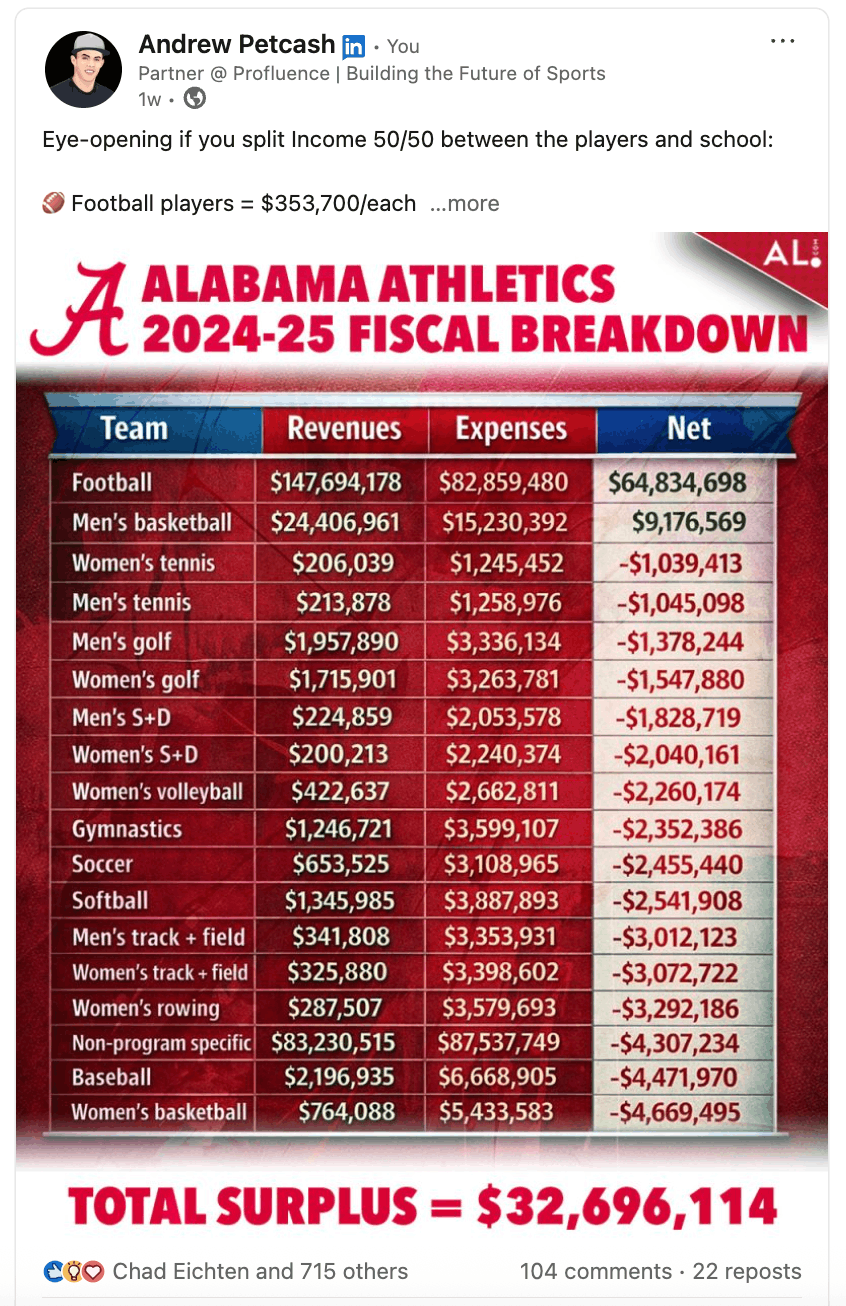
If you split the income 50/50 between the players and the school:
🏈 Football players = $353,700/each
🏀 Men's basketball players = $381,400/each
That post blew up. And it sent me down a rabbit hole.
So I decided to play around with some math/models (and explore some of the topics we’re all wondering about).
College Sports Right Now
College athletics is professional in everything but name; a Collective Bargaining Agreement (CBA) is inevitable at this point.
A CBA defines a few main things:
How revenue is split (media rights have exploded in college)
Salary structures and caps (NIL has become pay for play)
Free agency rules (transfer market is bonkers in college)
Benefits and healthcare
Dispute resolution
Length of contracts
If the NCAA doesn’t structure it, the market will structure it for them.
The History of CBAs in Football and Basketball
The NFL and NBA didn’t wake up one day with clean 50/50 revenue splits…
So before we talk about what a college CBA could look like, it’s worth understanding how professional leagues got here.
NFL Timeline
1920: Founded
1956: NFLPA formed (36 years later)
1982: first revenue-linked compensation system strike
1993: True free agency + modern salary cap formed
2000s: Modern ~48% revenue share structure solidified
Franchise valuations exploded once revenue definitions were standardized and player share was negotiated; because the NFL was financially modelable.
NBA Timeline
1946: Founded
1954: NBPA formed (8 years later)
1998–99 and 2011: Major lockouts
Interestingly, before 2011, players received roughly 57% of basketball-related income (after the 2011 lockout, that number reset to roughly 50%).
College
1869: Football began
1891: Basketball began
1906: NCAA formed
2021: NIL arrives
For over 100 years, the model was amateurism (no revenue sharing, no labor frameworks, no collective bargaining).
If we map it to the pro league evolution phases:
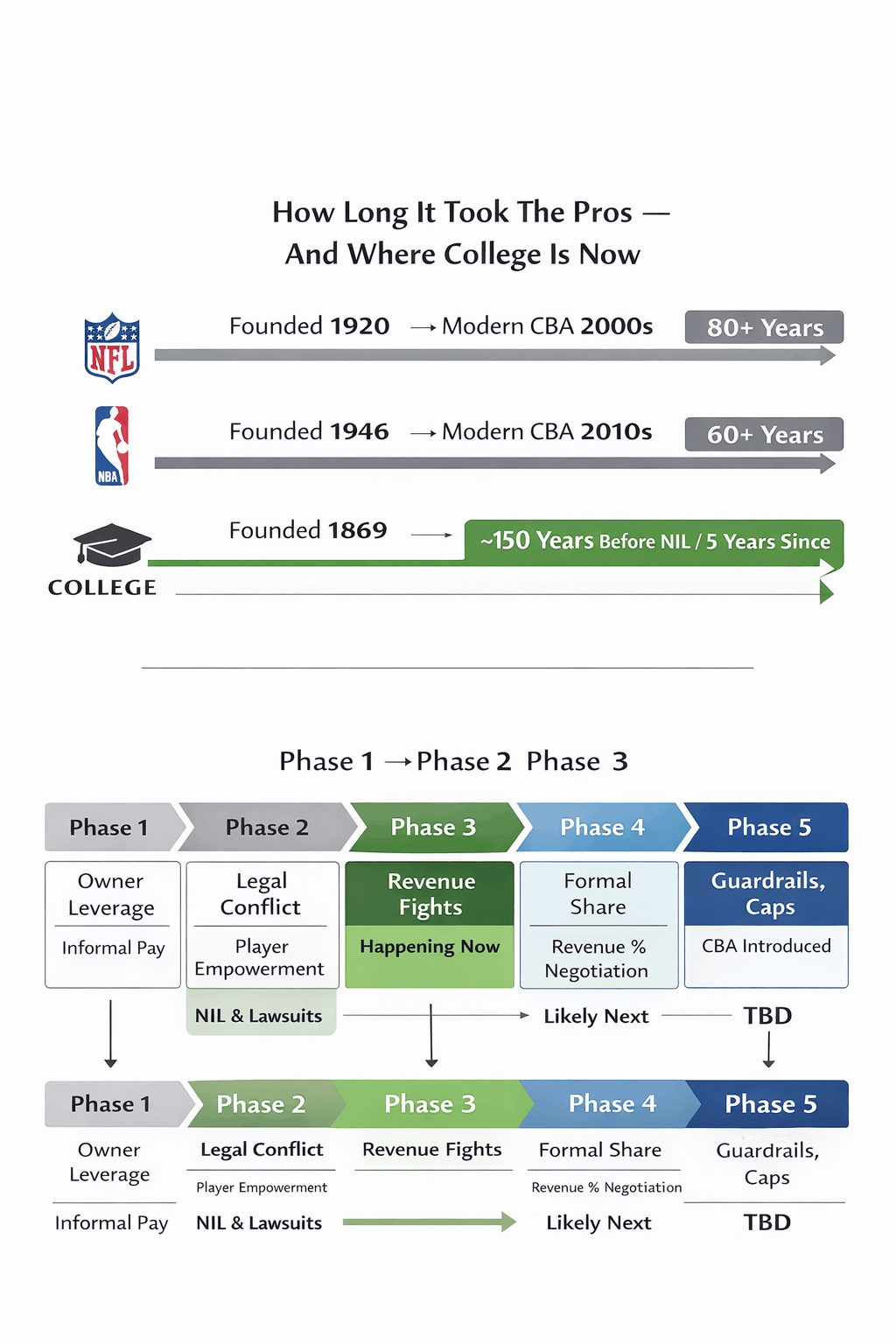
College sports are currently in Phases 3 and 4, effectively skipping 50 years of gradual evolution because the revenue infrastructure is already in place (and they’re now figuring out the labor structure).
Who Is Trying to Become the College Players’ Association?
If college sports moves toward a CBA structure, one obvious question follows:
Who sits across the table?
In the NBA, it’s the NBPA.
In the NFL, it’s the NFLPA.
In college sports?
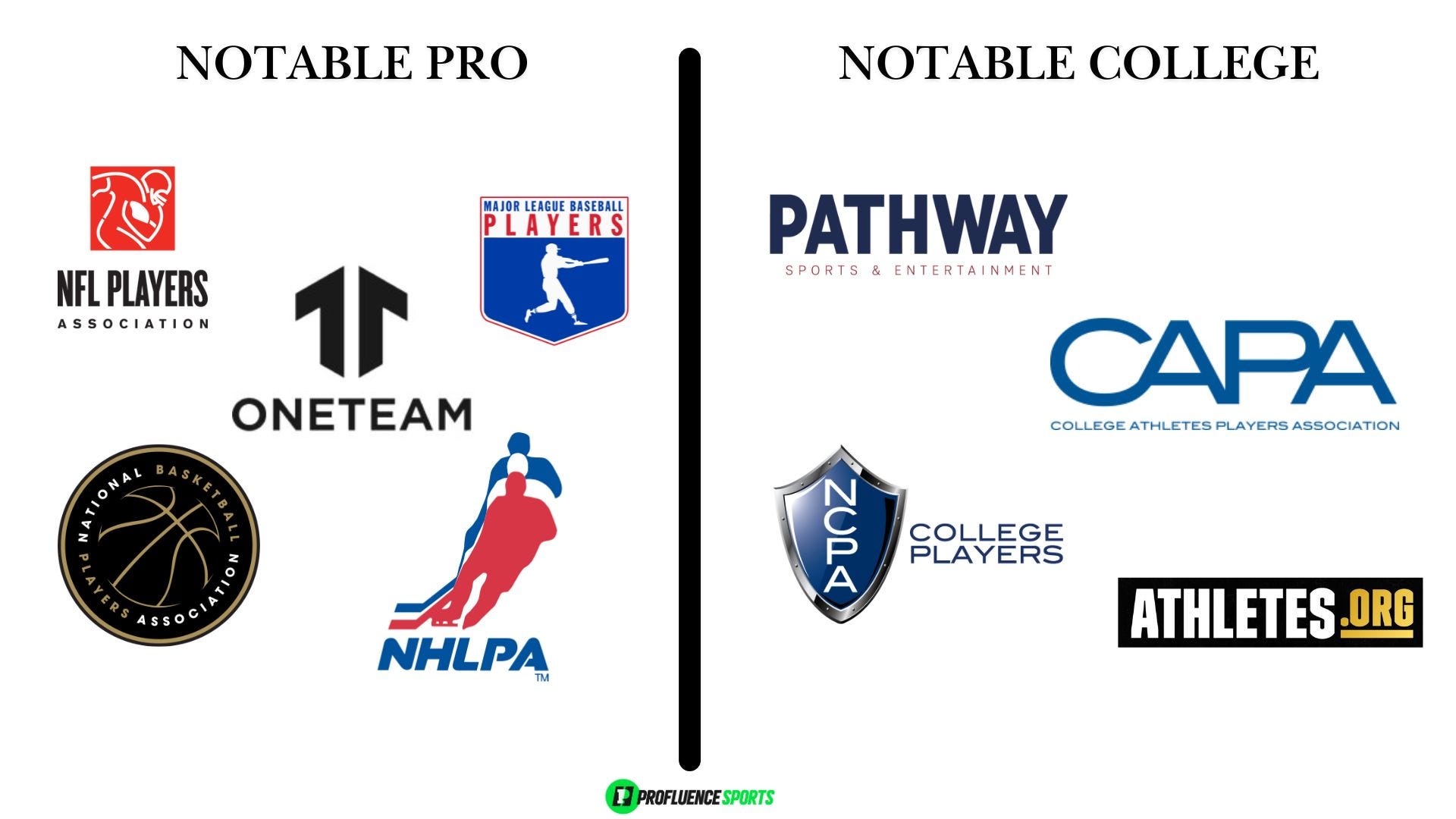
There is no officially recognized union (with many positioning for the role):
1. Athletes (.org)
Has released a draft college CBA framework and engaged thousands of athletes. Most explicit attempt so far at building a structured bargaining model.
2. NCPA (National College Players Association)
Longstanding advocacy group pushing athlete rights, health protections, and compensation reform for over two decades.
3. CAPA (College Athletes Players Association)
Focused on labor classification and unionization efforts, testing the employee argument legally.
4. Sport-specific advocacy groups
Football- and basketball-focused organizations that could consolidate into formal bargaining entities if legal recognition shifts.
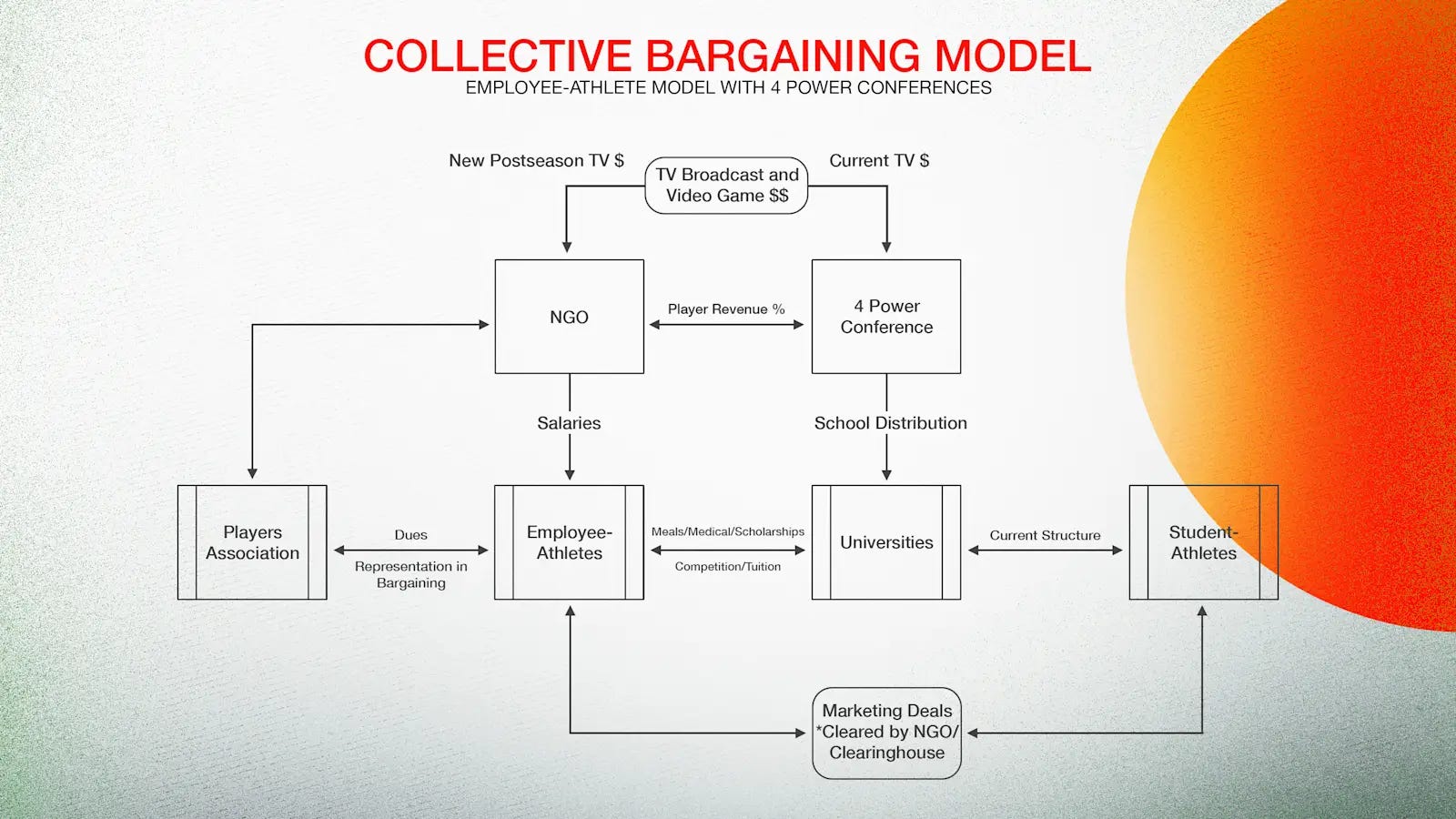
Once revenue sharing formalizes, the question won’t be “if” there’s a players’ association.
It will be “which one.”
The Core Economics Driving the Conversation
The economic pressure is that if you share profits, the money comes from football and men’s basketball (as most Olympic sports operate at a deficit).
Ways to Split the Pool
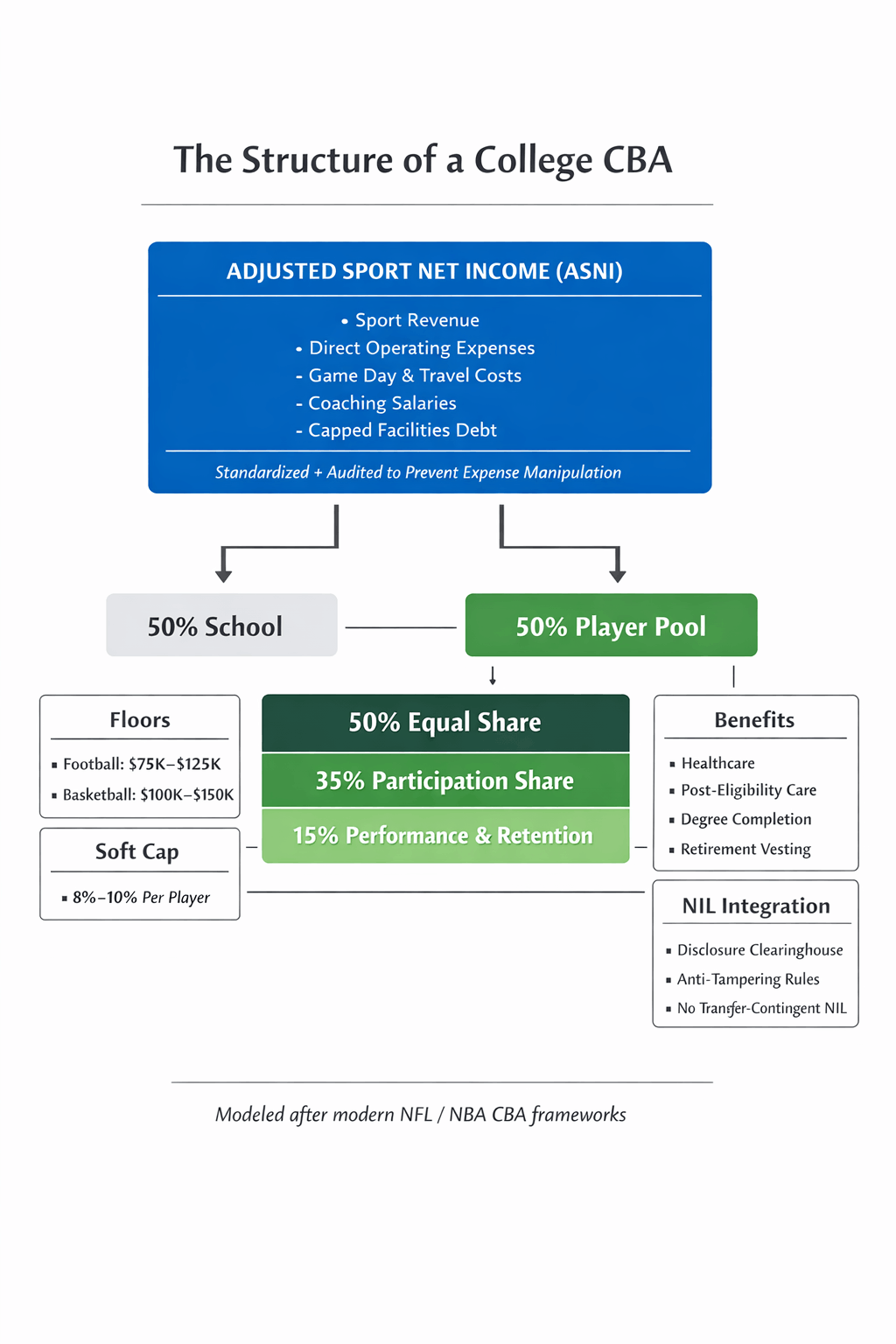
There are many ways to distribute a player pool besides an equal split or pure participation.
Here are the most relevant categories, and what they optimize for:
Hybrid split
A blend such as 50% equal share and 50% participation.
This is the most stable because everyone gets meaningful pay, while performance is still rewarded.Position-based market value
Allocate by position groups first, then distribute within groups.
This mirrors real sports labor markets, especially in football.Team performance multipliers
Hold back a portion for championships, playoffs, bowls, and tournament advancement.Revenue driver allocation
Use viewership, jersey sales, social engagement, and star power proxies.Seniority and retention weighting
Rewards continuity and staying in the program.Scholarship cost offset first
Guarantee scholarship equivalent plus a stipend, then split the profit above that.
In practice, hybrid distribution is the default because it balances stability, fairness, and incentives.
A workable model looks like this:
Private Equity Entering
We’re now also seeing private equity firms enter the space.
Which makes sense, but is interesting timing considering it just recently entered the NBA and NFL.
Without getting too specific, there are two main models:
school/athlete monetization platforms (Utah x Otro Capital)
conference-level structured capital/financing vehicles (Big12 x CAS)
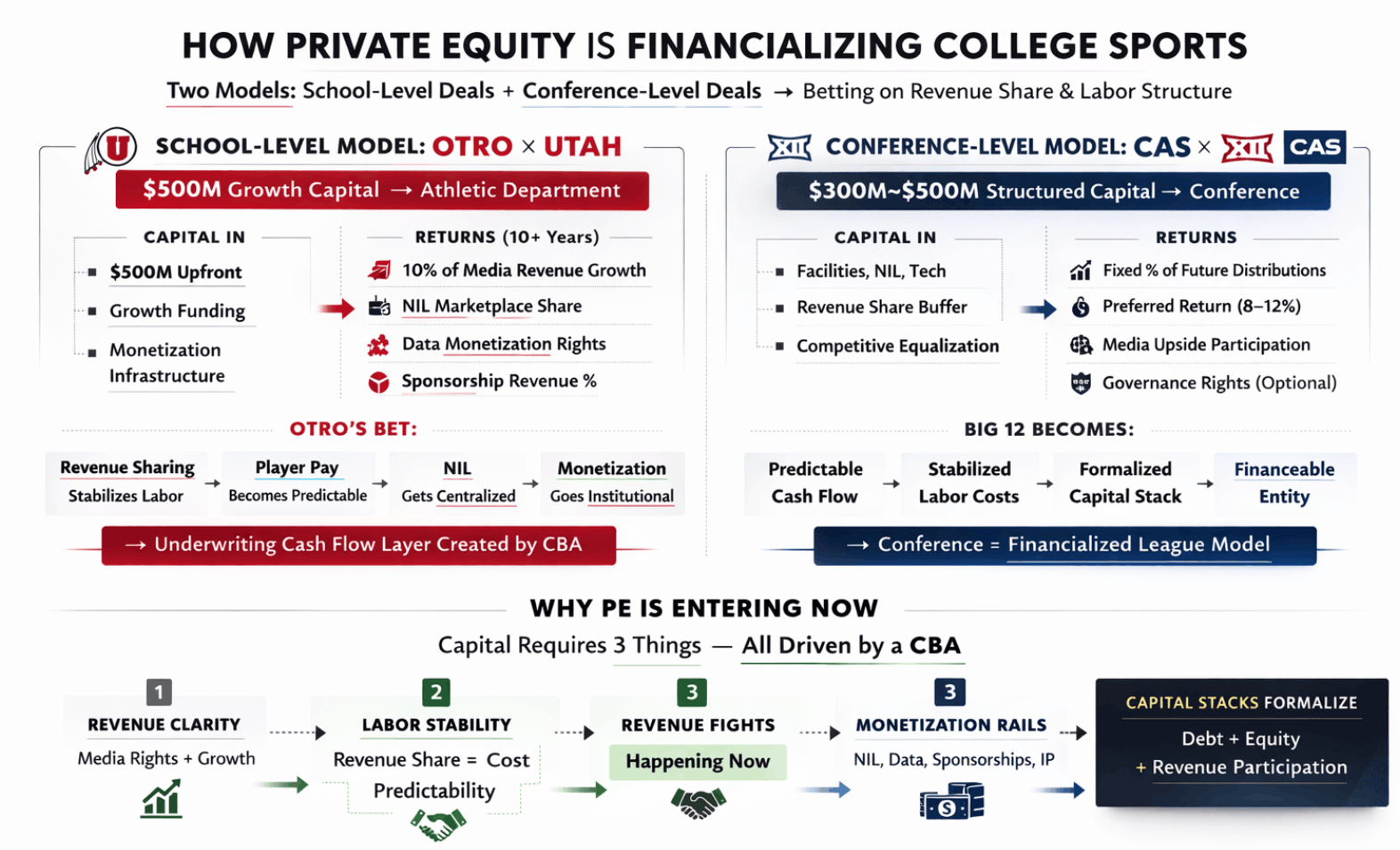
Both are essentially:
Professionalization infrastructure as they’re buying cash flow participation, media revenue slices, monetization rails, and distribution leverage.
What Happens to Olympic Sports?
Football and men’s basketball produce most of the surplus. If you share surplus only from those sports, you are concentrating new cash compensation in men’s programs.
That creates pressure in three areas:
political and reputational risk for universities
legal and compliance risk under gender equity frameworks
internal budget pressure that may lead to Olympic sport cuts
How Olympic sports get squeezed
When new mandatory spending enters a budget, athletic departments look for flex:
travel cuts
staff consolidation
roster size reduction
facility and ops tightening
in worst cases, sport elimination
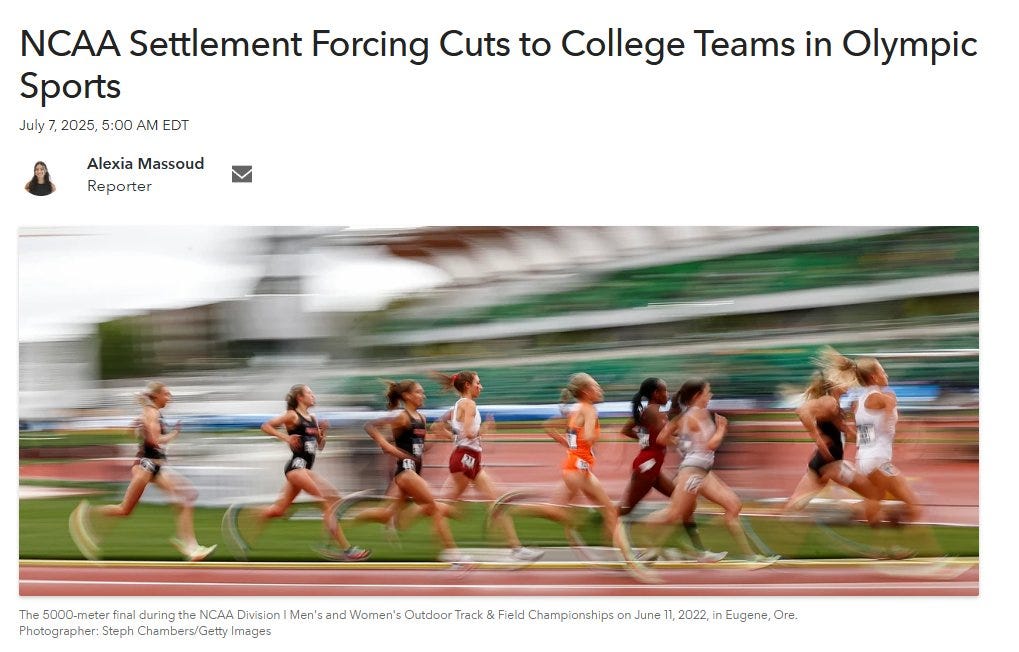
Historically, Olympic sports are more exposed because they tend to have high travel costs, large rosters, and low direct revenue.
So even if the intent is “pay football players,” the knock-on effect can be “trim non-revenue sports to fund payroll.”
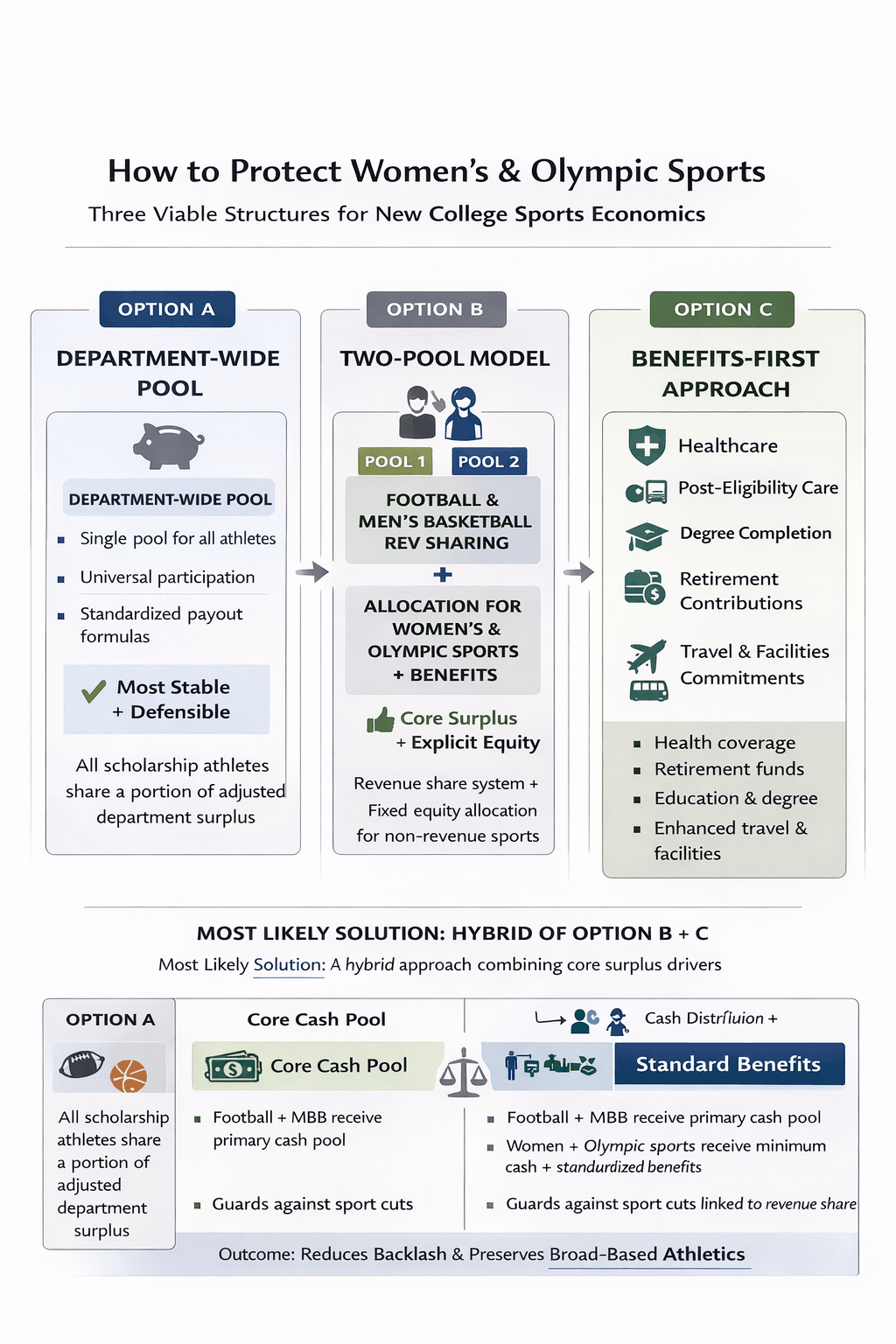
What schools will do to protect women’s sports and Olympic sports
If the NCAA wants a system that lasts, it needs an explicit design for non-revenue sports.
I believe there are three viable structures:
Where Are The Opportunities?
College sports are still messy, but the chaos is starting to highlight where some of the opportunities will be, especially as legislation and structure get sorted out.
For founders, operators, and investors, I think these are some of the opportunities:
NIL Agencies (this will eventually standardize and the 20% cuts will be reduced to 3-5%, handful of folks playing in this space, but if you win a niche it’s a massive opportunity, larger agencies will acquire smaller players here).